
Image by DariuszSankowski from Pixabay
My portfolio consists of two main sections, created during my master’s program at University of San Diego. Throughout my continued education, I explored a variety of learning technologies while creating artifacts for different learning experiences. With each artifact created and asset assembled, a new journey was created with its own purpose and goal.
As I approach the finish line of my master’s program, my philosophy remains the same: Each learning experience is it’s own adventure, designed to be enjoyable and intentional.
Similar to story writing and games, I have taken on a role of a creator rather than a consumer and, with this experience, I have come to curate cornerstones of several complete and incomplete learning experiences. From redesigning an existing course for improvement to creating a microlearning course that solves a problem, each artifact is the result of careful reflection from the perspectives of a learner and instructional designer.
The Parent Orientation Unit Showcase & Reflection
The first learning experience showcased in my portfolio is a parent orientation I created earlier on in my master’s program. This parent orientation was designed after careful analysis of the situation at an after-school learning center and discussion with relevant stakeholders. This was the Setting and Audience I needed to understand before I could begin visualizing the adventure I wanted to create for my learners. The portfolio showcases five artifacts, four of which ultimately result in the final prototype. The flowchart shows the learning paths that the reader will take within the course while the job aid and “Guide to Checking Student’s Progress” microlearning artifact serve as short scaffolding and review that my learners can access post-training. Each artifact presented on the “Parent Orientation Unit Showcase” page is a reminder to myself regarding the level of intentionality that is required when designing each learning experience.
Intentionality Is a Non-Negotiable
From introducing the learning content, to providing real-world scenarios and application opportunities, this course prototype was designed with my learner in mind according to evidence-based practices. In the future, this course will serve as a reminder that a good well-rounded, holistic adventure is one that leaves the learner satisfied when every lesson comes back full circle. If a learning experience is missing that satisfaction, a necessary step was omitted. Good design takes time, multiple revisions, and thorough tests. When a design is carefully tracked and visible to not just the designer, but the audience and stakeholders, the learning experience becomes more refined and ready for learners to embark on their adventure.

Parent Orientation Course Prototype
Try out the prototype by clicking on the image of the title slide!
Task Prioritization Unit Showcase & Reflection
My second portfolio showcase focused on my most recent learning experience design while exploring emerging learning technology in 2026. This learning experience featured more diversity in modes of engagement including an Articulate Storyline module with an animated video and AI voiceover. With the increasing presence of AI-generated content, this course was my means to navigate the conveniences of generative AI while maintaining my own autonomy and responsibility as a learning designer. While the use of AI made creation and research speedy, it also presented a set of dilemmas regarding errors in the generated content that I could not readily fix and a rising need to regain control over my own creative process.
The three artifacts showcased on this portfolio page highlight the learning technologies I explored, including Elevenlabs, an AI voice-generating platform; 7taps, a short-form slide deck creation platform; Adobe Character Animator, a video puppetry creation platform; and Genially, a learning game creation platform. These platforms open up many new possibilities and combinations for future learning adventure designs, but with such a wide variety, there must also be caution. Although providing many modes of engagement is recommended in CAST’s Universal Design for Learning, it is important to remember that a learning experience does not always require engagement and practice. Too much practice becomes busy work, which makes the otherwise formerly enjoyable learning experience turn sour. A habit that I would like to consolidate as a learning designer is to ask myself: What is the purpose of this artifact within the overall learning experience? Do I run the risk of repeating the same experience twice, leading to redundancy?
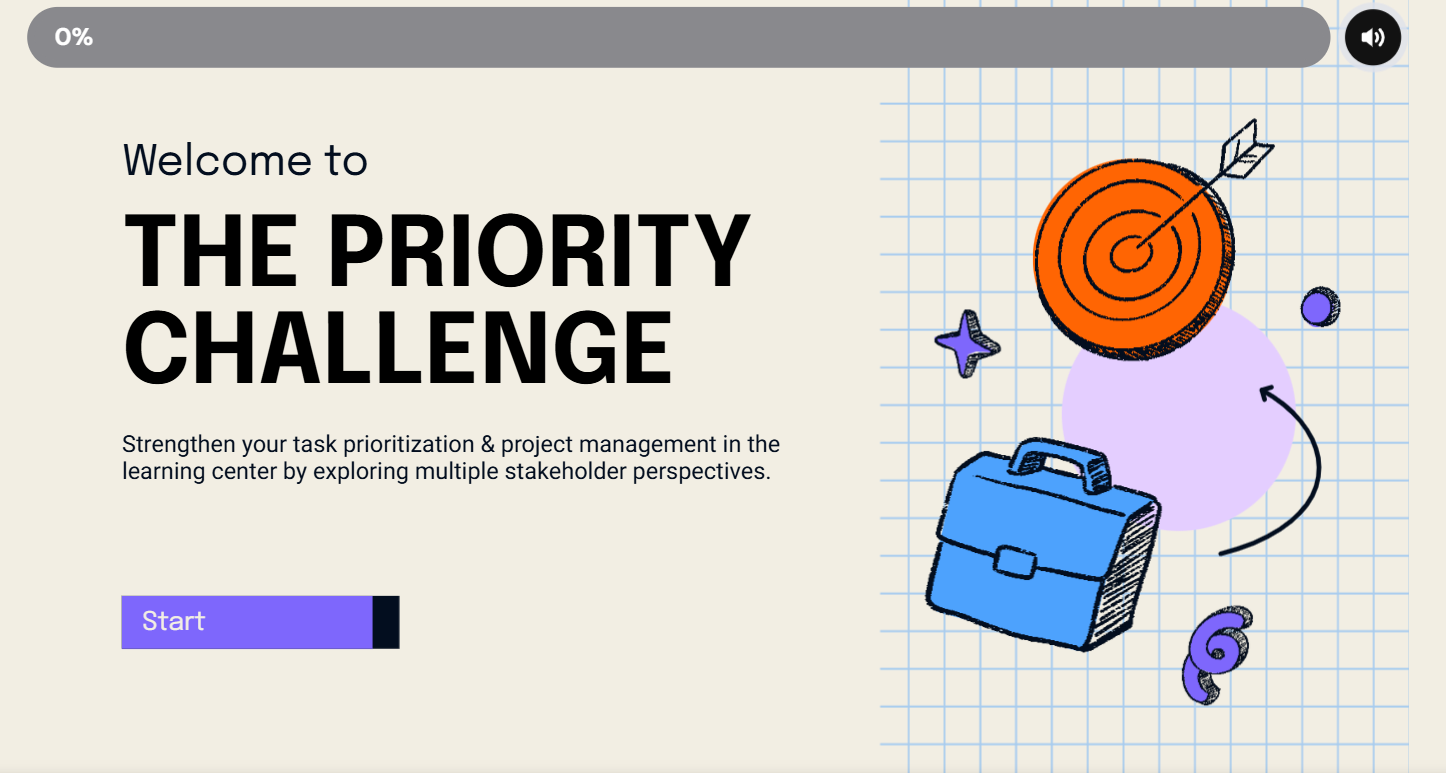
My Learning Game Using Genially
Click on the image to play the role of an after-school learning center manager as you navigate tasks within your workweek and disruptions that compete for your attention!
Redefining “Enjoyable” within My Philosophy
An impactful article from a recent course that I would like to revisit is “Game Over or Game On: Knowing When Gamification Is Right for Your Course” by BWoods from the E-Learning Heroes website. Always consider whether gamification is needed. A major assumption that I make is that a learning experience must be fun. This is a goal I strive for every time I create any learning content. However, as the Chinese proverb goes: “A forced melon is not sweet” (or 强扭的瓜不甜 (Qiǎng niǔ de guā bù tián) ). Forcing an experience on my learners without considering who my learners are and their interests can disengage my learners before the learning takes place. Learning about these risks and assimilating them into my experience as a learner has changed my philosophy slightly in redefining what “fun" and “enjoyable” learning experiences mean to me as a learning designer.
Moving Forward with Learning Design
As a learning designer, there is still much to learn and many opportunities for growth as new learning technologies emerge and best practices are redefined. I will continue to strive to design learning experiences that balance evidence-based practices with opportunities for learner engagement, and I will keep my learners and audience at the forefront of my designing process, including accessibility and Universal Design for Learning. On my journey to cultivate myself as a designer, learner, and story lover, my portfolio may change and update in the near future as my philosophy continues to evolve, so I thank you in advance for joining me on this journey.
